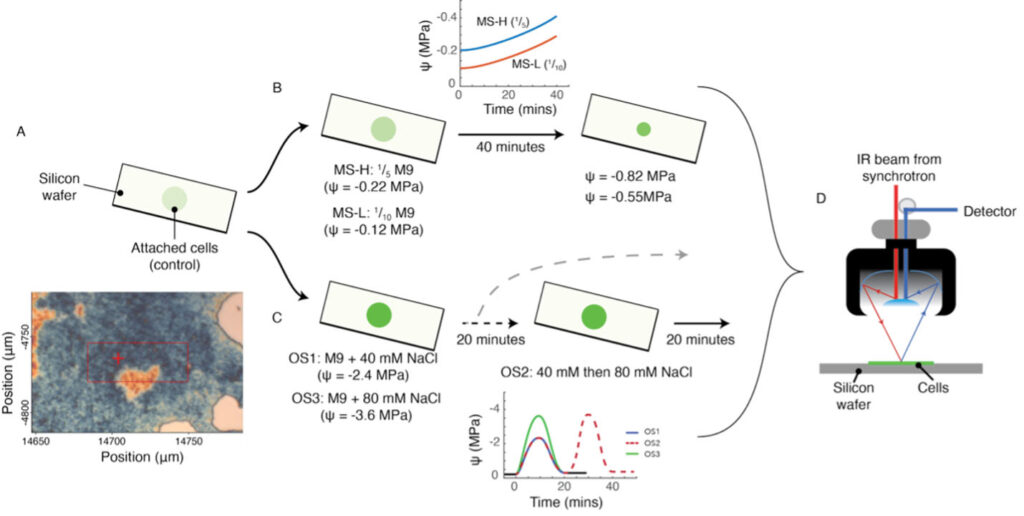
A schematic of the approach used to manipulate the water potential to which the soil microbes were exposed during the experiment. The microbes’ responses to the changing environmental conditions were observed in real time using a form of non-destructive live-cell imaging known as synchrotron radiation-based Fourier-transform infrared spectromicroscopy. (Credit: Nicholas Bouskill)
The Science
Soil microbes employ different mechanisms to survive drought conditions, such as going dormant or upregulating pathways that help maintain their water balance. However, insights into the extent to which these responses are shaped by the microbe’s long-term evolutionary history or local environmental history have remained limited, constrained by the availability of appropriate imaging and analysis methods capable of revealing real-time insights. One of BSISB’s capabilities, synchrotron radiation-based Fourier-transform infrared spectromicroscopy, offers a non-destructive, live-cell approach, capable of recording microbial responses to changes in environmental conditions.
The Impact
Understanding how soil microbes respond to drought, flooding, or changes in salinity levels has the potential to help scientists predict how different ecosystems might respond to changing environmental conditions associated with climate fluctuations. These insights could further help farmers in drought-suffering regions choose new agricultural strategies based on insights into interactions between plant roots and their soil microbes.
Summary
The BSISB team from Lawrence Berkeley National Laboratory in collaboration with users from Colorado State University first isolated bacterial strains of interest from two distinct environments, a semi-arid site in Colorado and a humid tropical forest in Panama. Four bacteria species were selected from each site based on phylogenetic similarity, for a total of eight bacteria strains, allowing for comparison of a total of four sets of similar strains living in these distinct environments.
Various fluctuations in environmental conditions were explored by first exposing the bacteria strains to different stressors, like increased salinity levels or simulated drought. Then, bacteria were transferred to silicon wafers and allowed to attach themselves. This provided a sampling surface for synchrotron radiation-based Fourier-transform infrared spectromicroscopy investigation of the bacteria strains, to observe biochemical changes that occurred in response to the environmental stressors. Each recorded spectrum captured information from about 20 bacterial cells at a time.
The team found that under conditions of osmotic stress due to increased salinity exposure, the bacteria upregulated certain signaling pathways, quickly turned over lipid-storage compounds, and increased the production of water balancing and protective compounds. In contrast, conditions of matric stress, also known as drought, led to a less prominent response that generally included enhanced production of compounds associated with carbohydrate stress.
Importantly, comparing the responses of the four sets of phylogenetically similar bacteria strains recovered from the two different locations revealed the importance of climate history in how the strains chose to regulate their responses to the environmental stressors imposed by the researchers. Additionally, the team found that the strains from the semi-arid location in Colorado exhibited a stronger response than the bacteria from the humid tropical forest in Panama.
The researchers concluded that the stress responses exhibited by soil bacteria in the face of drought conditions are more diverse than previously recognized – and that both the long-term evolutionary history and local environmental history of a bacterial strain contribute to the responses exhibited.
The Lawrence Berkeley National Laboratory is home to the Berkeley Synchrotron Infrared Structural Biology (BSISB) program, where the infrared experimental aspect of this study was carried out. BSISB is funded by DOE-BER, and the Advanced Light Source, a DOE Office of Science user facility.
Contacts
Hoi-Ying N. Holman
Molecular Biophysics and Bioimaging, Biosciences Division, Lawrence Berkeley National Laboratory
[email protected]
Nicholas J. Bouskill
Earth and Environmental Sciences, Climate & Ecosystems Division, Lawrence Berkeley National Laboratory
[email protected]
Funding
This project was supported in part by the U.S. Department of Energy, Office of Science, Office of Biological and Environmental Research under Contract No. DEAC02-05CH11231[EB1] .
Publications
N.J. Bouskill, et al., Climate history modulates stress responses of common soil bacteria under experimental drought. The ISME Journal, 19. (2025). [doi.org/10.1093/ismejo/wraf075]